Sunday, February 21, 2010

Nakon Ratchasima


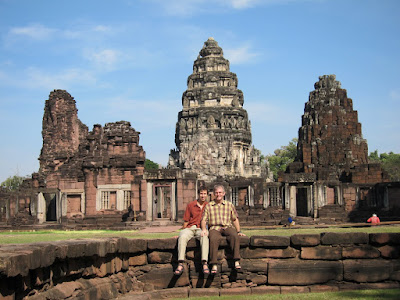
Nakon Ratchasima also goes by the name Khorat, which wikipedia tells me is a shortened version of its ancient name Angkor Raj. We didn't come to Khorat to see anything in the city itself, but instead to see some of the great ruins nearby, Phimai and Phanom Rung.


Nov 22 - Nov 24

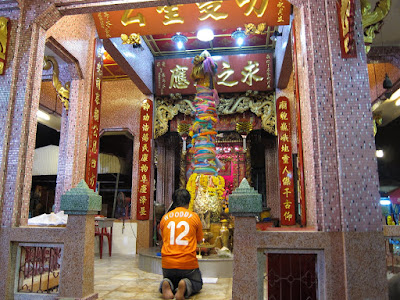
Nakon Ratchasima also goes by the name Khorat, which wikipedia tells me is a shortened version of its ancient name Angkor Raj. We didn't come to Khorat to see anything in the city itself, but instead to see some of the great ruins nearby, Phimai and Phanom Rung.* Khorat did have a night market, which we visited, and we happened by the City Pillar shrine. Each city in Thailand has a City Pillar, where the guardian spirits of the city live. It seems usually to be gold in color and covered with sheer silk wrappings. There's always been someone praying at it when we've walked by - I read that the City Pillar is where you go to pray for children.


From Thailand 2009 - Khorat


*[This is probably a good time to point out that "Ph" in Thai is pronounced more like "P" by itself, not "F" as you might expect. The ruins are "Panom", and "Pimai". A slight aspiration is okay. --Danny]

We'd originally planned to have a rental car here, since the ruins are quite a ways outside of town, but since we didn't, we hired a car+driver (which was as cheap as renting just the car). Somehow this got us a luxury van in which we were able to read and play Gameboy on the way to the ruins. Having a driver made things very efficient, and we were also able to see an additional smaller site, Prasat Muang Tam.

These ruins are both from the Khmer empire, like Angkor Wat in Cambodia (its ancient capital), so they share a lot of Angkor Wat's distinctive features like the tall prangs and the arched hallways.


From Thailand 2009 - Khorat


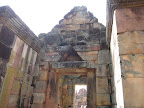
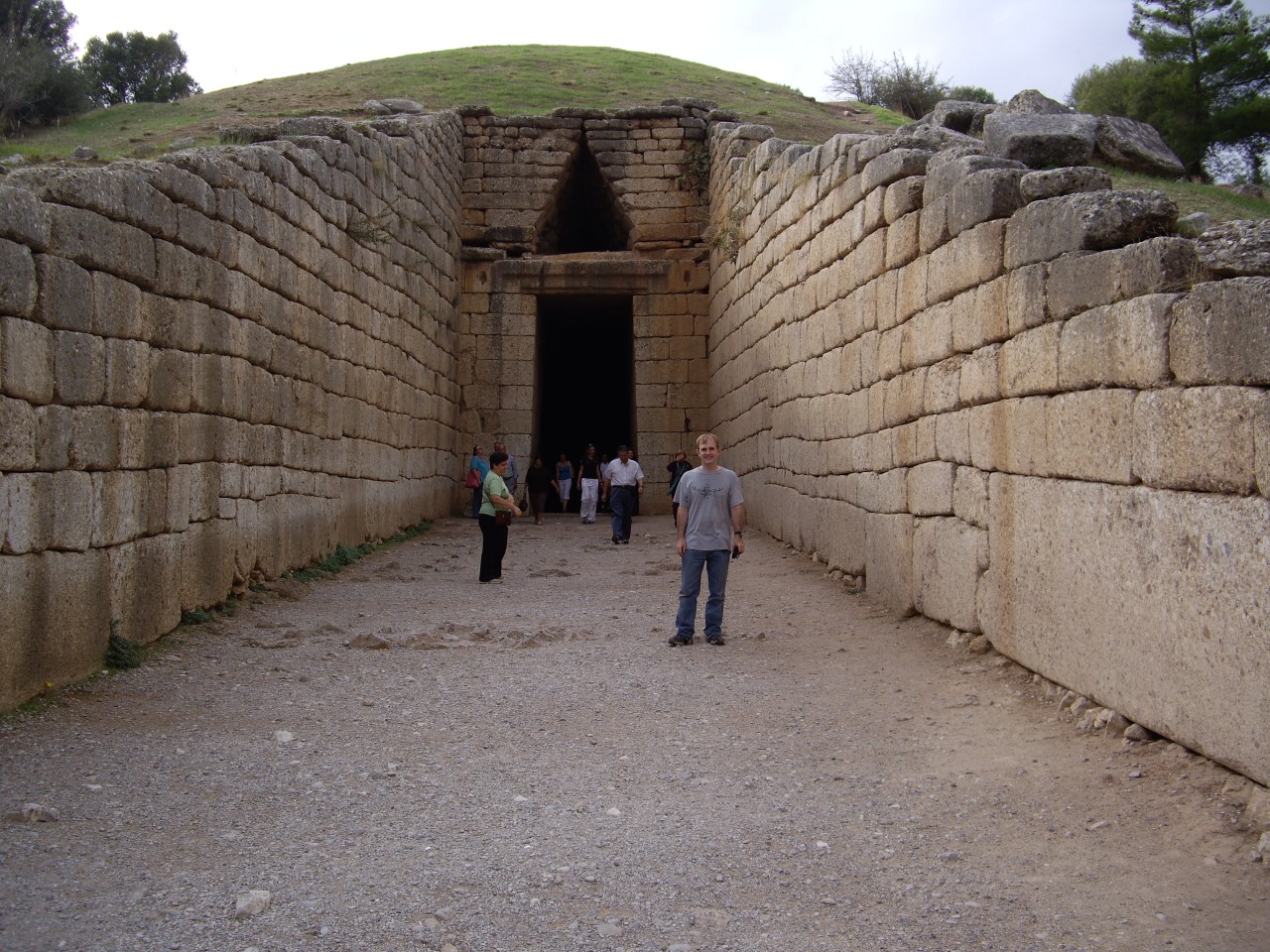
Two architectural features we saw at these sites also reminded us of other, unrelated, places. Phimai had an entry hall with a number of pillars packed closely together, which we both thought (independently of each other) resembled the Hypostyle halls we'd seen in Egypt. More surprising was the triangular hole above the lintel* at Prasat Muang Tam, which was exactly the same as the way the ancient Myceneans did it.

*[This is called a corbel arch, and (I just read) was used by many ancient cultures. --Danny]


From Prasat Muang Tam From Mycenae


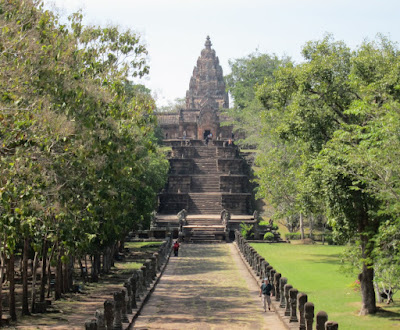
Both sites were amazing in the detail of the carvings. Almost every surface of the buildings was covered with carvings, even the floors in some cases. Phanom Rung had the most impressive carvings overall, especially the justifiably famous lintel carvings of Vishnu and Shiva. Quite amazing to think that these have survived since around 1150 AD. Phanom Rung was also impressive for the massive staircase and walkway that lead up to the main temple complex.


From Thailand 2009 - Khorat


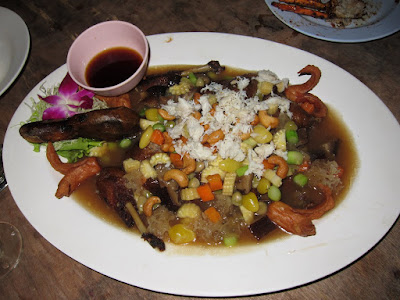
One evening we went to a restaurant that someone in town had recommended called Vangmatcha. It seemed to be more of a local's date place than a tourist stop (not that many people seemed to be visiting Khorat). In was unusual in that each group got their own hut on the dock of a small lake. The waiters took orders and delivered drinks by scooter, and the food showed up via motorboat. Another point which was really driven home here is how highly regarded the hot dog is in Thailand. Danny ordered a platter of smoked duck, and it came served with hot dogs split and cooked to make them look like some kind of flower.


From Thailand 2009 - Food


More Photos...


Read more!

Sunday, February 7, 2010

Phitsanulok


Hey guys, sorry about the long delay since our last post. Internet access in New Zealand is really spotty and expensive, plus we've been up to our eyeballs in adventures and have set aside very little time for things like blogging, postcards and laundry. Now that we're about to leave, we've managed to slow down enough to put up some old news: last year's adventures in Thailand. Yipes, we need to catch you up to the new decade. Here's hoping we find time for that soon. --Danny
8-22 November

While visiting Sukhothai, we stayed in a small town, Phitsanulok. We'd intended to stay for only a day, hit the ruins, then head on, but we amended our plans so we could get some more caves in. Ryan will wrote about those already; I'll be covering the town and its night markets.

Food and Markets


Phitsanulok has several night markets – two for food and one for clothing. We checked out all three, but one of the food markets was too far away from our hotel to be useful. (We stayed in a nice, large hotel on the other side of the river from the central downtown, but the walk was short and the weather was nice enough for walking.) As for the other markets, I bought some shorts from a small-run clothing designer at the clothes market and we frequented the food market nightly to buy both supper and cave lunches for the next day.

My favorites cave lunches were some sort of pork krapow (though I never got the actual name for it - it was a spicy stir fry that may have been krapow) and a delicious barbecue dried beef, like jerky. I'm sure I saw this being made later and it's a good thing I'd already eaten and enjoyed some because otherwise I'd be too horrified at the bowl of raw meat strips sitting out, curing in the sun. For us, though, it was a lightweight and easily packable lightweight lunch.

The night market in Phitsanulok also introduced me to one of my favorite Thai dessert-like dishes, faktong sankiya: steamed pumpkin stuffed with custard. The pumpkin is hollowed out and filled with custard batter, then the whole gourd is steam-cooked. The pumpkin is sweet (and probably has an extra sauce applied to help it out there) and the custard is eggy. I've also seen it served with nests of egg yolk candy garnish.

Faktong sankiya
Pumpkin & custard dessert (from Food in Thailand)


We tried going to one of the recommended (Lonely Planet) restaurants, but had a language failure. They had no English menu nor picture menu, so the only dishes we could order were the smoked duck curry (mentioned in the Lonely Planet) and something selected rather arbitrarily (it turned out to be serpentheaded fish in a dry red curry). It was on our walk back from the restaurant that we visited the distant food market, which was, for some reason, suddenly swarming with western tourists. They were crowded around the fried insect vendor, making me wonder again if fried insects are only sold to and consumed by tourists (but I've read otherwise). This vendor also had fried scorpion for sale, black and shiny with sharp claws and needle stinger. Ryan may have been dared to try one, but, alas, he was too full already.

Phitsanulok happened to have the best noodle soup I had this whole trip. Maybe that's an exaggeration (and Ryan will scoff or *roll eyes* at my possible hyperbole), but the soup was just so delicious, and I have no idea what it's called, or even really what's in it. One night - maybe the first night in town - we were looking for food and I was pretty hungry, when suddenly I smelled something delicious, like cloves and cinnamon. I looked around, and only saw a big bowl of chopped greens, but sure enough, the sweet smell was coming from them. I had no idea what the vendor was selling, but I pointed to the greens and said I wanted some of that. Shortly after that, I was given a bowl of noodle soup including the chopped vegetable of unknown kind. There were large peppery, white balls of fish or pork, perhaps, and a tasty broth, and of course the vegetable. In my notes, I wrote that I saw the same vegetable, I thought, at a buffet with an identifying tag calling it "caisim," though this note could refer to something else, I suppose. I also thought I started to identify the greens as chopped morning glory. In the end, I have no idea what it was, and why it smelled like cloves and cinnamon to me. But boy was it good, and it was of course only 20฿.

Phitsanulok's Wats


We also stopped at a couple of the local temples. One of Phitsanulok's temples (Wat Phra Ratana Mahathat) houses a famous image of the Buddha called the Chinnarat Buddha, and it's got a legend to go with it. Supposedly there were to be three Buddha's cast for the temple, at the commission of a 14th century king (Li Thai). The first two images were cast just fine, but the third kept breaking. Finally, a mysterious white-robed sage showed up out of nowhere and helped them make the last image. I think he's the one who suggested that the Buddha be wreathed in flame, but for whatever reason, the Chinnarat Buddha introduced this novel pose for the Buhhda, and it's gained the reputation for being the most beautiful Buddha in Thailand. Chinnarat means "Victorious king."

Chinnarat Buddha
Chinnarat "Victorious King" Buddha (from Phitsanulok)


Across the street from the Chinnarat Buddha is an older temple (Wat Ratchaburana) with several historic artifacts which are attached to some quaint local customs. The king once arrived in Phitsanulok by royal barge, I guess, because now there's an old royal barge (like an oversized Venetian gondola) on the temple grounds. The custom here is to make a wish then crawl under the length of the boat three or nine times (!). It's a long boat, so this would take a long time. I went ahead an wished (for good caving) and then banged my head during the first pass under. By the third crawl, I was slithering under there like a pro, or like a caver :)

Wat Ratchaburana also has a gong which you must rub in a gentle way to make it ring, and some sort of sacred tree which must be climbed three or nine times. The copy of the Lonely Planet that we had mentioned a ladder, I think, but in fact there was a plain staircase leading up and over a low branch of the tree. It looked pretty boring, so we skipped that custom.

Crawling under the royal barge
Three times under the royal barge (from Phitsanulok)


About 12 km out of town, we kept passing a gigantic reclining Buddha on our way to the caves. We finally managed to pass by during regular visiting hours, so we stopped to check it out. The wat (Wat Kok Mai Deng) is crazy like a mini-golf park, with brightly painted plaster statues everywhere, and of course the big Buddha. The reclining Buddha has a tunnel through its chest, and the monk there told us we needed to walk through it and around the entire Buddha. Fortunately, we only had to walk around it once, not three or nine times.

Giant Buddha
Giant Buddha (from Phitsanulok)


The Buddha was obviously freshly painted. While we were looking for the name of the temple, we came across someone else's pictures of before the shiny gold paint job:

Unpainted giant Buddha
Unpainted giant Buddha (from Thailand odd spot - someone else's blog about Thailand)


We chatted with the young monk a little more, and then we fed the fish in the pond there with a bowl of bread crumbs he gave us.

Next stop, the bus to Nakon Ratchasima!


More Photos...

Read more!

Monday, January 18, 2010

Phitsanulok Caving


After our caving experiences in the far north, we decided to spend some additional time on caving. Looking at the maps, Phitsanulok was near a number of interesting sounding caves, including the longest in Thailand, so we added three extra days to our stay in Phitsanulok. This was probably a bit unusual, since Phitsanulok is more of a travel hub than a destination itself. Sukhothai and a famous Buddha are the main reason people come there, so most only stay for a night or two. We also had to rent a car, since the caves were about an hour outside of town. This proved to be more expensive than we had hoped, since the big rental company (Budget) had shifted their inventory south to handle the Surin Elephant Roundup, but we did manage to get one.


Nov 19 - Nov 21

After our caving experiences in the far north, we decided to spend some additional time caving. Looking at the maps, Phitsanulok was near a number of interesting sounding caves, including the longest in Thailand, so we added three extra days to our stay in Phitsanulok. This was probably a bit unusual, since Phitsanulok is more of a travel hub than a destination itself. Sukhothai and a famous Buddha are the main reason people come there, so most only stay for a night or two. We also had to rent a car, since the caves were about an hour outside of town. This proved to be more expensive than we had hoped, since the big rental company (Budget) had shifted their inventory south to handle the Surin Elephant Roundup, but we did manage to get one.

The plan for the first day was to explore a string of caves along a limestone cliff. In the cave database I was using, there were five caves along this ridge of lengths ranging from 60m to 3.7km. The first target was Nam Tok, a small cave but fairly easy to find once we were in the right area. With the help of Google Maps, we navigated the network of ever smaller roads to the right area and parked beside a mango plantation. A trail led through the plantation to almost the bottom of the cliff. The last 5 meters would have been easier with a machete though, as it was covered in prickly vines and horrible biting red ants about 3/4 of an inch long. We did find a cave in the area indicated, right behind the pools in the orchard, and the water at the entrance was mostly gone, which made it an easy entry. The cave itself was fairly small, but offered a couple of interesting nooks to explore.

Nam Tok, from Phitsanulok Caving


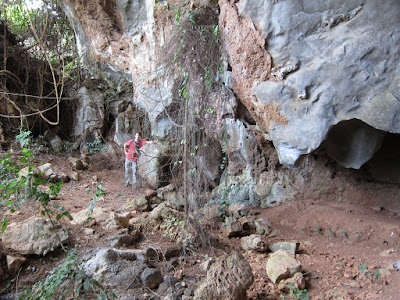
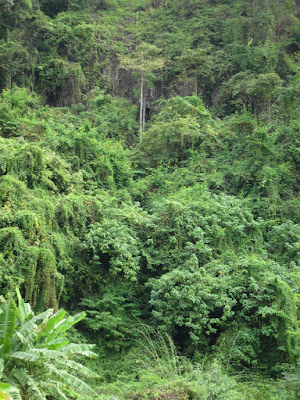
The second target was the 3.7km cave, Khang Khao. The description indicates that it would be also be easy to find, since it had an "obvious" entrance that could be seen from the road. We did see a dark hole partway up the cliff face and tried to make it there. Our first attempt failed, and we had to exit and memorize the vegetation and angle of approach and try again. We made it, but it turned out not to be the right cave, just a little depression in the side of the cliff. We found one cave entrance that seemed to meet the description, except rather than an easy boulder climb down to a stream bed, it was a boulder climb followed by a good 10 foot drop to the next foothold, and then maybe climbable to the streambed another 15 or so feet below that. With no ropes, we had to abandon this. I did see a skylight about 30 feet or more above me in this cave, which also fits the description of Khang Khao. I'm not sure what happened to the "easy scramble", as I didn't see any rubble in the stream passage. Maybe we just missed something?

All this climbing around the jungle and the cliffside took several hours, in the heat of the day, and was discouraging. So we returned to the car and drove up the road a bit to try the caves on the other end of the cliff. We found one very easily, but it was filled with deep water. It was getting late in the day, so I was reluctant to go for a swim. I also couldn't tell if this was the 1.7km cave or the 60m cave. One had no description at all, and the other could have fit it. Continuing along the cliff, we found another wet cave, and then a narrow but very tall stream passage. Very muddy, but no swimming. This was also fairly short, and later I found out was probably Hornet Cave. However, the distances between all of the caves involved don't match up.

Hard to find caves, from Phitsanulok Caving


Since we were unfamiliar with the area, we want to make sure we got out by dark, so we called it a day.

---

The next day, we decided to try for the longest cave in Thailand, Tham Phra Wang Daeng, a 13.6km cave. The directions to it were pretty straightforward, as it was on the grounds of a wat. We found the wat without too much trouble, but the small dirt road it was on meant travel was slow. Once we got to the wat, it was a short hike to the cave entrance. We encountered a lone monk (and several dogs), and tried to explain what we were there for. I'm not sure he understood.

On the way to the cave we saw the strangest Buddha I saw the entire time I was in Thailand. It was a large one, maybe 15 or 20 feet tall, and painted to be lifelike, rather than the typical bronze or gold color, or natural stone. But what made it really strange is that it was surrounded by a huge cylindrical chainlink cage. Maybe to keep animals out?

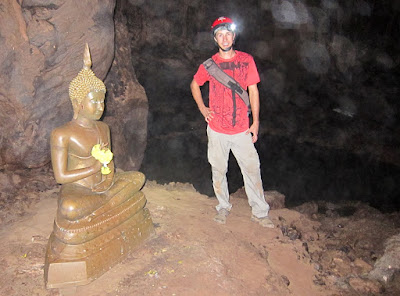
The cave had an impressive entrance, a huge opening surrounded by jungle. The entrance chamber was filled with rubble and sloped down to a riverbed. Fortunately, the monks had created steps here and there to make it easy to get down to the river. At the base of the slope, in the darkness by the riverbank, we were surprised to see a lifesize golden Buddha. This was actually very helpful, since it made it easy to know when to get out of the river for the exit path.

River Buddha, from Phitsanulok Caving


We proceeded upstream, and were quickly distracted by a pretty waterfall, where we took some pictures. Further along, we came to an area where we knew we might have to swim. Sure enough, it was deep, and there was a rope tied along points in the ceiling to guide you through the dark water. I wasn't sure that getting wet right away was best, and we'd had a slow start this day, so this was a good point to stop for lunch. We'd gotten some food from the Phitsanulok night market, all wrappped up in plastic bags, which worked great for cave food. The best was the spicy chicken kra pow, which we got several days, and something like spicy beef jerky, available coated with a sweet sauce or without.

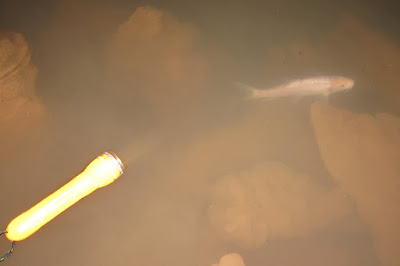
As we were eating, I noticed that our lights had attracted some attention - cave fish! I'd been in cave with fish before, but never been lucky enough to see any. This cave had huge ones, longer than my hand, and completely white. They seemed not to be blind in that they appeared to be attracted by my light shining into the water.

Large cave fish, from Phitsanulok Caving


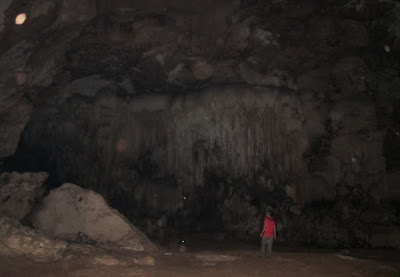
The cave description we had mentioned that there was a bypass on one side of the river by going up and around. However, the description of the bypass was unclear as to whether you should go right or left - both led to an upper passage, but only one was a valid bypass. And we didn't yet have a clear understanding of the map (not to mention that it was a blurry jpg that I couldn't read any text on). We ended up choosing the wrong one, of course, but it led to an amazing set of chambers, the largest of which was a huge curving room, 40 meters by about 80 meters according to the map. By spreading out a couple of our lights in the room, we could get an good idea of the scope of it. The only cave I've been in that was larger was Mammoth Cave in Kentucky. We explored this area for quite a while, and every once an a while happened upon another large Buddha that the monks had somehow brought in here - down the rocky slope, along the river, and up a steep mud and rock climb.

Big room, from Phitsanulok Caving


Eventually we figured out that this was not the bypass and finished our exploration of the area and headed back down to the river. It was getting into the late afternoon, but we had time for a quick swim up the passage to at least see what was on the other side. The water was cool, but at this point that was mostly a refreshing feeling since the cave was much warmer than the caves of New England that I was used to. The water was comfortable to be in, once you'd gotten over the slight shock of getting into it. The river varied from waist to chest to swimming deep for maybe 100 meters before it came to a set of rimstone dams. We took a look and then headed out because we wanted to make sure we could get the car back on the highway well before dark.

----

We'd had a lot of fun in Wang Daeng, and only gotten to see a tiny portion, so we decided to spend the final day in Phitsanulok visiting it again. I now wish we'd extended our trip another day or two and continued to work our way further into the cave, as it turned out to be one of my favorite things in Thailand.

On the second day, we were quicker to find the place, since we didn't have to hesitate and check directions every once and a while. We descended down to the river and considered the downstream direction, which had some possibly unexplored leads. After climbing over some boulders, we did make some progress in this direction, but everything eventually petered out. After consulting the map, it looked like we'd have to go all the way back up to the entrance chamber and around to it's other side and them back down to get to where we could actually follow the stream again.

Instead, we went back upstream to the place where we'd gone to the upper chambers yesterday, and took the slope up on the opposite side of the stream. This one was a bit steeper, but the monks had tied a number of knotted ropes around to help with the ascent and descent. We got to the top, and again were in an enormous room, about the same width and height as the one the day before, but longer. It was so large, in fact, that I was unable to keep track of exactly which direction I was heading as we wandered through it the first time.

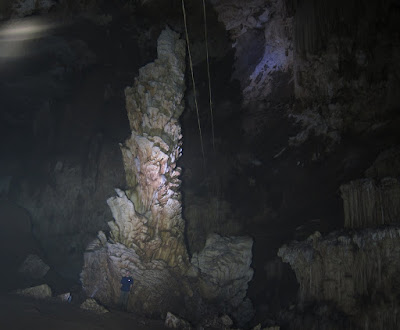
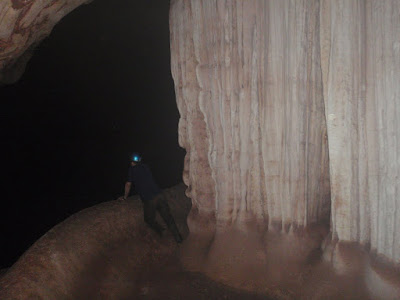
In addition to having a couple large Buddhas, it had a pair of the umbrella trees that the Thais use. There was also a platform that seemed like it should have a Buddha, but didn't. Behind that platform was a crack passageway that wasn't on the map. It went a short distance, but eventually pinched out. On the opposite side of the room, we did find the way back down to the stream, ending up only about 150 feet beyond where we'd turned around yesterday.

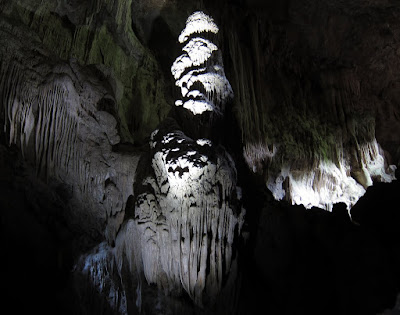
Big formation, from Phitsanulok Caving


Beyond this point, the cave became more regular - a passage varying from 10 to 20 meters wide and about 25 to 30 meters tall. The stream ran through the bottom of the passage, filling it almost from wall to wall, except for periodic sandbanks on the sides. So we'd travel for a short distance on one bank, and then have to wade across the river to the other side. Typically the water depth was about waist deep in the middle, but there were a couple deeper spots, one of which led to swimming (and leaving the backpack behind). We found an unsurveyed passage indicated on the map, but it would have required some ropework so we didn't follow it.

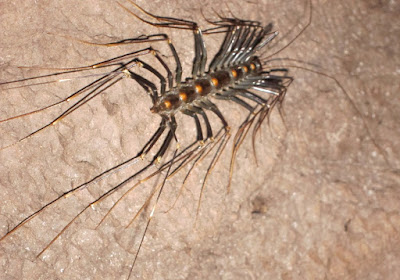
At one point we ran across a particularly large sandbank, perhaps 10 or 15 feet high at the highest point. In one place, water had dripped down from the ceiling far above creating a pit in the sand with a rim of little sand stalagmites. Hanging out in the pit was one of the couple cave centipedes that we saw. Nearby, I found a small crevice that was very muddy. We followed it as far as we could, but just ended up making a mess of ourselves. Cleaning the mud off in the river attracted the attention of some of the cave fish, which would nibble at your hands and toes, whatever was in the water.

[I experienced the blind cave fish first-hand quite well, several times. My first encounter was a while back in the cave, where there was an island in the middle of the river with a tunnel in it. I was playing around in the tunnel, perhaps trying to pose for a picture, when I got my first wellie. What's a "wellie"? This: In a prior trip report from some other cave explorers, it was mentioned that the blind white cave fish "occasionally nibbles their wellies." Were these boots? Perhaps "Wellingtons"? I started calling the fish bites "wellies."

[The nibble itself was gentle, but startling. The cave fish seemed to be curious about anything in the water. If I moved my hands or feet around in the water, they left me alone, but once I stopped, they swam over to investigate the new thing. Once they came close, they nibbled at me. My first wellies was on the leg, while I was trying to stay still for a picture. It surprised me, but was over before I knew it. Later, more fish nibbled my shoes and hands as I washed mud off them from a narrow mud canyon we explored. When my thumb got nibbles, I jumped. Getting nibbled anywhere - even on the shoe I was holding in my hand while washing it - made me jump. Wellies indeed! They're toothless, at least, so it felt like getting pinched by a rubber glove when you're just not expecting it. Even when you expect it, it's sudden and startling. The feeling reminds me of the fish spa, but with fish the size of kittens and mouths large enough to eat eggs. That's a wellie. --Danny]


Cave centipede, from Phitsanulok Caving


Nearby (I think), we found another small passage, this one quickly opening up into a dome shaped room. This room was unusual because it had a perfectly flat floor of mud. Stalactites hung down from the ceiling and penetrated the floor. I dug around one, and it continued several inches below the floor.

By this time, it had gotten late again, and it was time to turn around. On the way back, we found a path that we'd missed, high on a bank, and decided to spend a little time following it. It went up and up, nearly to the ceiling, and eventually into an upper passage. The passage consisted of a set of rimstone dams, with the final one being taller than waist high. Standing at it, you could look out and down into the blackness of the main river passage, like being on a castle parapet. It was far too high for me to see the river below with just my headlamp. The room itself had a convex floor in the center, and stepping on it caused a booming sound, as it if were hollow underneath, so I kept to the walls. Around the back side of the dome was a small meditation chamber, complete with floor mat and incense.

Rimstone parapet, from Phitsanulok Caving


We returned back to the river and followed it to the bypass (helpfully marked by the monks with a bit of cloth tied to a rock), went up, down to the river, and then down the river to the Buddha marking the exit path.

On the way to the cave that day, we'd noticed a considerable police presence on the road. In one place, half of the highway had been blocked off. In another place, we'd seen a crowd of people wearing red shirts. This turned out to be an anti-government dissident group that's been causing a lot of trouble recently, relating to the exiled prime minister and television star (see wikipedia). Fortunately, when we returned, these were all cleared up.


More Photos...


Read more!

Tuesday, January 5, 2010

Sukhothai


Leaving Chiang Mai and the north behind, we're now heading east to the city of Phitsanulok for more caving and our first real Thai ruins. Perhaps because of a nearby elephant festival several towns away, there were no rental cars available, so we took a city bus directly to the Sukhothai ruins. When we arrived, we spent some time trying to find the best place to rent bicycles (a recommendation from the Lonely Planet, but one we decided to follow), and while we were doing so, we ran into some Cave Lodge pals.
November 18, 2009

Leaving Chiang Mai and the north behind, we're now heading east to the city of Phitsanulok for more caving and our first real Thai ruins. Perhaps because of a nearby elephant festival several towns away, there were no rental cars available, so we took a city bus directly to the Sukhothai ruins. When we arrived, we spent some time trying to find the best place to rent bicycles (a recommendation from the Lonely Planet, but one we decided to follow), and while we were doing so, we ran into some Cave Lodge pals, Graham (the Scot) and Ima.

The city of (ancient) Sukhothai is about an hour outside Phitsanulok. It is considered the first Thai Kingdom, and reigned for 200 years starting in 1238. Chiang Mai itself was established by a Sukhothai king in 1296, and the height of Sukhothai power came in the 15th century. During this time, artistic styles moved in a new direction as the influence of the kingdom grew. As a result, there are some very beautiful Buddhas and chedis among the ruins.

I hope our pictures speak for themselves, conveying the majesty of these ancient ruins, but there are a few highlights I'd like to mention specifically.

Wat Si Sawai


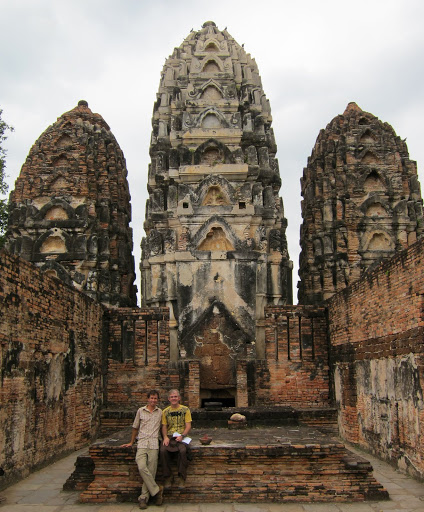
At Wat Si Sawai, there were hundreds of birds nesting in the crooks of the prang. We had fun stomping on the ground to make them take off into the air and trying to capture it on camera. I think we don't have any good still photos, but I got some really great slow-motion video of the birds taking flight, which I hope we will be able to post soon.

Wat Si Sawai
Wat Si Sawai (from Sukhothai)


Wat Si Chum (Phra Atchana)


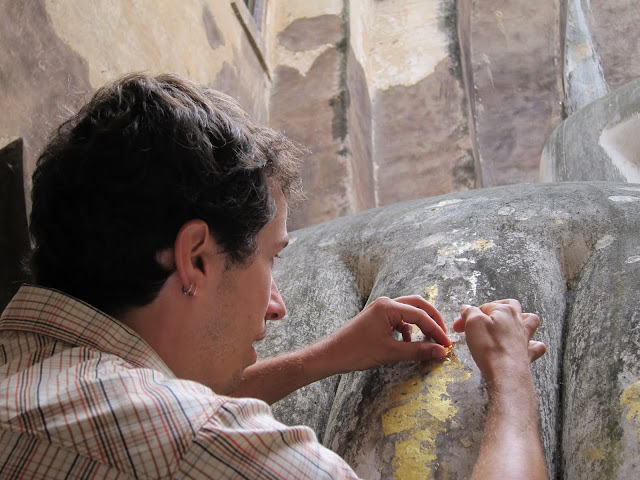
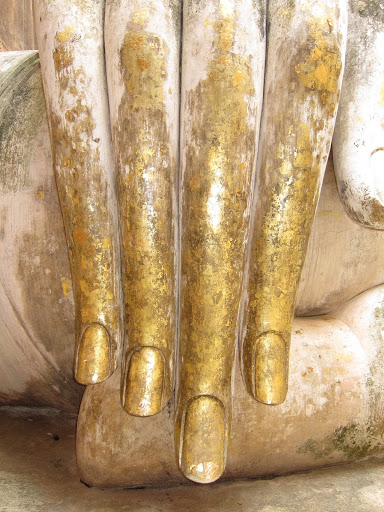
This is a famous Buddha that's put on hundreds of postcards. There's a practice of applying gold foil leaves to images of the Buddha as a beautification. This particular Buddha, believed to be the Phra Atchana mentioned in a famous historical text, has the fingers of one resting hand well-covered with gold. We had been hoping to get to do some gold leaf application in Thailand but hadn't found an opportunity to do so yet. We were lucky to find a souvenir stand near the Wat which was able to come up with a packet of gold foil when we asked, so we got to apply gold to the Phra Atchana during this visit.
Applying gold leafFingers of the Phra Atchana
(from Sukhothai)


Wat Chetuphon


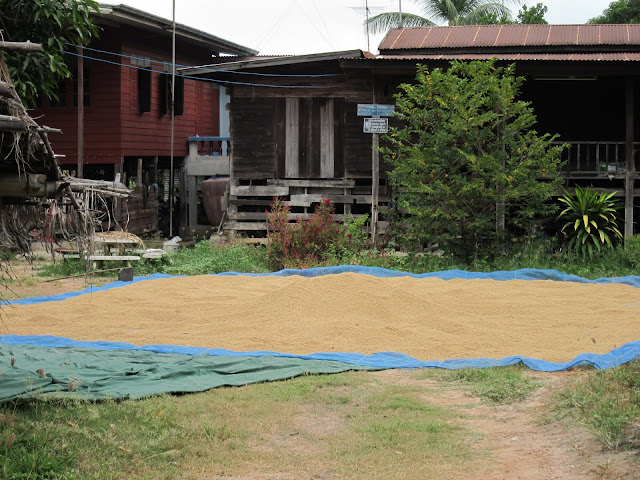
We biked out about a kilometer or so from the main ruins to Wat Chetuphon where there were four ruined Buddhas in four different poses. The statues were nearly gone, but there was enough of each of them to imagine what it had once been like. It was a fun bike ride out into the countryside for us and we passed many rural houses along the way. Many houses looked like they had little markets in their front yards; others had the rice harvest or water collections. On the way back we stopped for some khao gip - the sweet fried rice cracker that we'd had once in Chiang Mai - from a cart outside someone's house.

Rice harvest
Rice from harvest (from Sukhothai)


More pictures from Sukhothai here... Read more!

Thursday, December 31, 2009

Cave Lodge Caving


Our main purpose in traveling far up north to the Cave Lodge was to get some caving in. I had high hopes that we'd meet some fellow cavers there and have a lot of fun exploring the area. The Australian owner, who had spent decades in the region and sounded like a very interesting person was unfortunately out of the country on vacation. As he promised though, his staff took good care of us.

Nov 10 - Nov 15

Our main purpose in traveling far up north to the Cave Lodge was to get some caving in. I had high hopes that we'd meet some fellow cavers there and have a lot of fun exploring the area. The Australian owner, who had spent decades in the region and sounded like a very interesting person was unfortunately out of the country on vacation. As he promised though, his staff took good care of us.

However, there were some things which didn't turn out the way I expected. My main disappointment was that there weren't really any other cavers there. The place seemed to be more of a backpacker rest stop on the Chiang Mai / Pai / Mae Hong Son loop. Most people that stopped by only stayed a couple days, and the only caving they did was the kayak trip and the bird show (more about that later). This also caused a transportation problem, since we didn't have transport, and there weren't other cavers to pool with to rent a car or a car and driver.

My other disappointment was that it was hard to get to the caves. There were a relatively small number within walking distance, and even for those, the directions were somewhat vague. There were lots of maps, but in many cases the maps had conflicting paths to the caves, and it wasn't until several days in that we figured out which map was the most accurate for the local stuff. That one happened to be the one hidden in the kitchen, not the big one out in the main room, and not the photocopy given out on arrival. The staff tried to give us some help, but the language barrier made it difficult. They could at least tell us which were hard and which were easy to find.

Day 1

The first day we tried to find Green Corner Cave, Xmas Cave, and an unnamed cave, all accessible from one stretch of road. We didn't get an early start because I like sleeping late, so it was a hot hike out in the sun, with very little shade. We managed to find Green Corner fairly easily, but although the entrance was impressive, it was a pretty small (and mostly inactive) cave as far as we could tell. There were some big spiders, and one climb out of the cave looked a bit like Shelob's lair.

Green Corner Cave
Green Corner Cave, from Thailand 2009 - Cave Lodge


We continued on the road, but couldn't determine which path led to Xmas Cave. There was one well defined path, one stile into a field, one path that went steeply down into the same field, and one poorly defined path that skirted a stream. According to the information on the map, it could have been any of these. We decided to try and get more information at the lodge, and skip that one in favor of the next which looked like it had better landmarks.

Further along the road got very steep, along with the temperature getting hotter. The two landmarks we had to work with were a fire tower on the right and a ridge on the left. We hiked a long way (the map says "not to scale") and the ridge in the distance always seemed to be over the next rise. Just after we gave up and turned around, we spotted the fire tower - we'd passed it somehow without seeing it. The elevation of the bank on the side of the road hid it from view when coming up the hill. We considered climbing the fire tower, but the rungs of the ladder were made from skinny pieces of brittle bamboo which didn't look like it would hold either of us.

Finally, we found a substantial path heading off along the ridge. Although the time was getting late, we decided to follow it so we could at least find the cave, even if we had no time left to explore it. Eventually this path came to a gate which had a lot of brush stacked in front of it. We climbed over the gate and followed the path a bit more and came upon some huts which looked like they were in use. There was a Lahu hill tribe village in the area, but that was supposed to be the next path up on the map. Frustrated, we turned around and went back to the lodge. Later one of the staff told us that we could have asked them where the cave was.

Day 2

Since we hadn't had much success on our own, we decided to take one of the guided trips on the second day. We were most interested in the longer one, advertised as "4 to 5 hours of serious caving", but we needed a minimum group of 5 in order to get the price down to a reasonable level. Also, the staff told us that no one had done that trip in a while, so she'd have to check and see if the guide would still do it (he would). There were 3 other people there that we'd been talking to, and they were interested in doing a cave, and were willing to be talked into the long trip. So, Kyle, Isabel, and Katya joined us for the second day of caving on the trip to Tham Boon Hoong (also called Tham Pung Hung). "Tham" is the Thai word for "cave".

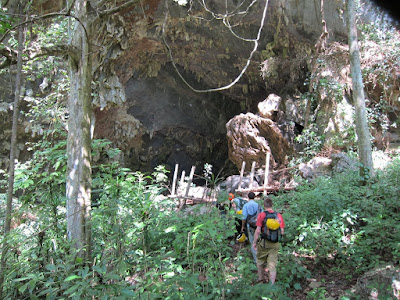
It was quite a trek to get to the cave. First, all five of us rode in the back of the Cave Lodge pickup over winding and occasionally poorly paved roads to get to the parking spot. This was on the edge of a small village, and overlooking a very hilly cultivated region which was studded with limestone outcroppings and knobs. Then we walked down a steeply sloped ridge that ran along the edge of some of the crops, including a couple bean fields. Along the way, our guide demonstrated how to shoot long grasses out of our fingers like arrows. Then, we went down the side of the ridge into a valley, which was even steeper. This was very jungle like, with huge stands of bamboo and muddy ground, even though it hadn't rained since we'd arrived. We picked our way down, crawling over fallen bamboo as thick as my thigh and dreaded the return climb. Eventually we arrived at the large mouth of the cave where there was a bamboo platform. I think it might have been built by the cave survey expedition several years ago as a place to camp. This cave is currently the 9th longest in Thailand, at 4.5km long, so you can imagine that the surveying might have taken a while.

Tham Boon Hoong entrance
Tham Boon Hoong entrance, from Thailand 2009 - Cave Lodge


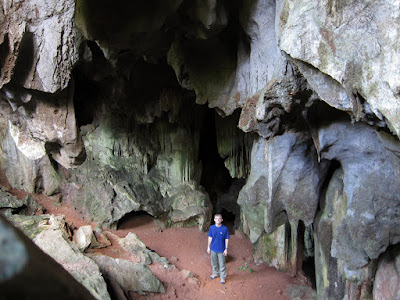
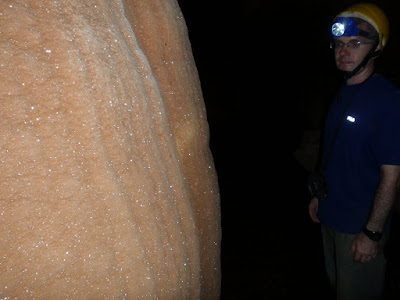
Boon Hoong is mostly walking stream passage punctuated with the occasional medium size room. There were about 6 crawling spots, several duckwalks or duck-unders, and 1 belly crawl toward the back. There were quite a few formations, and they were in very good condition. Unusually, there were very few large formations aside from flowstone, but many many groups of smaller ones. There was one section where a formation had built up on a mud bank, and then the mud bank had washed away leaving a shelf of stone which supported a pillar. Maybe the passage floods violently on rare occasions and this keeps most of the formations small? There were a lot of very white, delicate looking stalactites and a memorable piece of large brown flowstone that had a groove worn in it by a trick of water which had then deposited some small brown crystals. Unfortunately, it didn't photograph very well. In a nearby area, there was a large piece of beige flowstone which looked like it was covered with glitter (mica, I would guess). At one point we noticed on an odd formation high on a bank, and had to take a closer look. It turned out to be a miniature village that someone had sculpted by adding mud animals and details to a small formation.

Glittering flowstone
Glittering flowstone, from Thailand 2009 - Cave Lodge


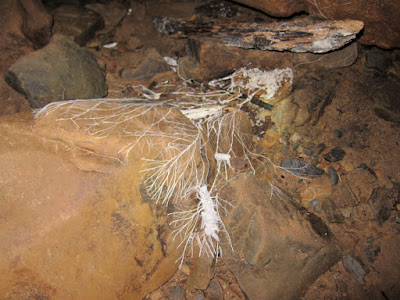
The cave had quite a bit of wildlife. Of course there were bats, but we also saw cave crickets (with really long feelers), cave crayfish that were translucent, crabs, some pale rolley-poleys, and an unusual fungus. Everywhere that we saw pieces of rotting bamboo in the cave, a thin white fungus was sprouting from it and spreading a delicate, root-like network as large as a couple feet in diameter. We saw one that seemed to be growing a stalk which Danny thought might be the fruiting body of a slime mold. Net research also shows a similarity to some wood decay fungi structures (mycelium). Does anyone know?

Bamboo fungus
Bamboo fungus, from Thailand 2009 - Cave Lodge


We turned around when we got to the point where the stream fell into a wide and deep pit - we'd joined the pit from the side, and couldn't see the bottom, even with our brightest lights. In all, we were in the cave for about 5 hours, including a break for lunch (fried rice and a chocolate muffin) and a shorter break at the same spot on the way out.

It was fun, and good to be caving again after a long dry spell, but I itched to explore the cave at a slower pace, rather than being guided through it. I found a map afterward, and there's only one significant side passage, but there were a lot of interesting looking areas that we passed by when we were in it. One other things to mention - we were all a bit surprised at how our guide was outfitted. He did the entire trip, caving and hill climbing, in dress pants and black slip-on loafers.

Day 3

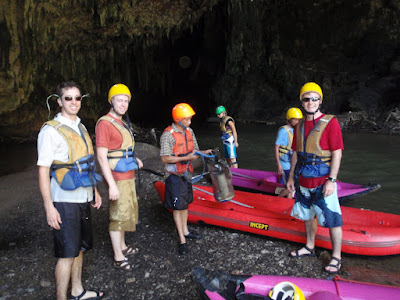
While we were at Tham Boon Hoong, Kyle's mother had tried out the kayaking trip that Cave Lodge offers. Cave Lodge sits on the bank of of the Lang River (Nam Lang), and you can get kayaks to run down the river, and through the huge passageway of Tham Lod, which is the major tourist attraction for the area. She thought this was a really fun trip, and suggested that we do it too. All five of us were up for it, so on our 3rd day of caving, that's what we did.

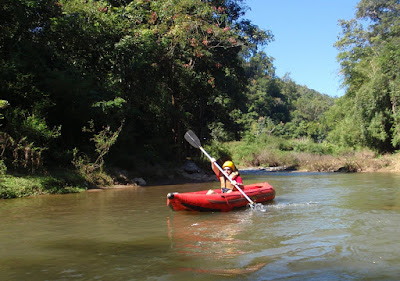
The kayaks were inflatables (mine had considerable patching with duct tape), and worked well except for some really shallow spots. Kyle and Katya each went with one of the guides (giving Kyle the ability to run a waterproof movie camera he had), Danny went with Isabel, and I was excited to go solo. The river itself was entertaining without getting difficult. Frequent, but small patches of Class I or easy Class II. Danny and Isabel ended up in a tree once, and I dumped shortly after entering the cave because I didn't turn quick enough. There were two surprise rapids on the trip - big concrete dams that we just went over, and down the steep ramp.

Ryan kayaking
Ryan kayaking, from Thailand 2009 - Cave Lodge


The portion through the cave was very short, we didn't even have time for our eyes to adjust before we were on the other side. The cave is listed as 1 km long, but there are two substantial side passages, so the river portion might only be 500m or less. Overall, this was a lot of fun. I enjoyed it even more than the caving the day before.

Cave kayaking
Cave kayaking, from Thailand 2009 - Cave Lodge


After we got back, we took a short break and then walked back to the river exit side of the cave. At sundown, there's a "bird show", in which a gigantic group of swallows, on the order of hundreds of thousands, fly into the cave while the bats fly out. It's an amazing sight - the birds start collecting outside as the light changes, and then there's a constant rush of them into the cave for about a half an hour or so. If you can get your eyes to adjust to the darkness of the cave rather than the fading light outside then you can see a huge wheeling mass of the birds flying in a circle in the big entrance chamber as they prepare to nest for the night. The bats are much smaller than the birds, so it's very hard to see them, and I'm not sure if I did or not. At one point, I could see a bunch of shadows on the rock moving in the opposite direction from the swifts, and smaller, but it could have been swifts flying back out. Maybe the bats use the upstream entrance to leave for the night.

Day 4

On the 4th day, we decided to try again for Xmas cave. We went back to the path that like the best match to the map, as well as the most trodden, and began following it. It started off going through a field of great smelling giant mint, past a motorbike that someone had left there, and off into the woods. We walked in the woods a long way, well after we left we should be looping back to the cave, until we found the path going up the hillside. This was possibly right, so we continued, past a creepy looking stone marker. Where the path crested a saddle, we began to hear sounds - chopping bamboo and singing. After listening a bit, we followed the path down to where a small group of people were building two bamboo shelters, similar to the remnants of ones we'd seen in earlier places along the path. They couldn't tell us where the cave was, only that it wasn't further along the path, presumably where they'd come from (maybe that Lahu hill tribe village?). So we backtracked to the road and examined the other possibilities, ruling everything out except the fenced path. We followed that through some old fields, one of which had been corn but now looked like it was growing wild with pumpkin. After some false leads, we almost gave up and turned around, but Danny persisted, and wanted to investigate the uppermost field, and quickly found the cave off to the side.

Danny in the field of mint
Danny in the field of mint, from Thailand 2009 - Cave Lodge


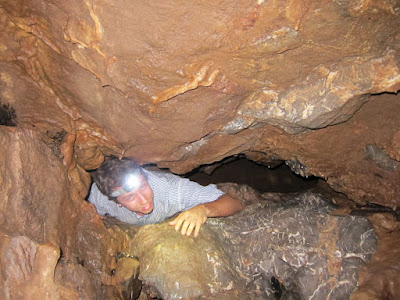
We geared up and spent about an hour and a half in the cave. This one was very different, as it was more vertical than horizontal. It went down and down, and we could see that this was an old cave with what had once been beautiful formations that had either fallen from the distant ceiling or been crushed by falling rock when rock dividing an upper and lower section had collapsed. At the bottom of the initial rockfall, we came to a tricky downclimb which led to a small stream passage. This led to an arched entrance into a room, but the entrance was 75% blocked by rubble, and the open upper part was guarded by the largest bats I've seen outside of a zoo - big, black ones, which I'd never encountered in the wild before. We skirted the guardians and followed the passage to a tight squeeze. Beyond that, the remainder of the stream that hadn't gone elsewhere emptied into a small pool. Danny crossed the pool and saw a crawling passage that went further, but due to the lateness of the day, we decided to turn around there. I later found out that this goes for a short bit to a dropoff, which then leads to the bad air cave nearby. So we couldn't have gone much further anyway.

Tight squeeze
Tight squeeze, from Thailand 2009 - Cave Lodge


On the way back out we took a few minutes to do some light painting style photographs, where you take a very long exposure and use your headlamp to paint the rocks with light, or to uplight a specific formation. This will allow you to take a picture of a much larger space than the flash can illuminate. They turned out pretty well, especially for a pocket camera.

Light painting experiment
Light painting experiment, from Thailand 2009 - Cave Lodge


Day 6

The fifth day at Cave Lodge was not for caving, but for visiting a hill tribe. (Danny will cover that in another post.) The sixth day was mostly spent driving around to see the hill tribe villages. However, we did stop and see Coffin Cave, which is one of the show caves in the area. Somewhere around 1200 to 2000 years ago, the people that lived in what is now northern Thailand buried some of their dead in hollowed out teak logs that they put in caves. There are about 60 caves that they've discovered with these coffins. This particular cave was long dry, and the coffins were very well preserved. The cave itself was mostly a collection of rooms in the hillside.

Coffin at Coffin Cave
Coffin at Coffin Cave, from Thailand 2009 - Cave Lodge


We'd had fun with the cave exploration, and the most fun when we were on our own. Since this was one of the premier caving regions in the world, and the caves were relatively open to access (compared to in the USA), we decided that we'd try to do some more caving later, and made adjustments to our trip to spend several extra days in the town of Phitsanulok, which had previously just been a stopover point for a Sukhothai visit.

More Photos...

Read more!

About This Blog

The accounts both factual and perceived of the international adventures of Danny and Ryan. We are two Californians taking eight months to visit various countries around the world, but this is not an "around the world" trip. We'll be using this blog to keep a record of our travels and share our adventures with our friends and families. Our itinerary is summarized here.

The title of the blog is based on one of our favorite exploration books, about a young man in the early 20th century who roamed the American Southwest from the ages of 17-19 years old, Everett Ruess: A Vagabond for Beauty.

  © Blogger templates Brooklyn by Ourblogtemplates.com 2008

Back to TOP